History
The layout was developed by the club to take the place of ‘Walmcompton’ which had passed it’s effective life. The initial planning took place in 2000 and shown in a very basic form at the club’s exhibition in 2002 and the first train to run was set off by the widow of Tony Frey, a long standing member of the club hence the name. Since that day it has been shown at a number of venues and because the layout is constantly being updated, we hope it will be invited to future exhibitions for some time to come.
The Layout
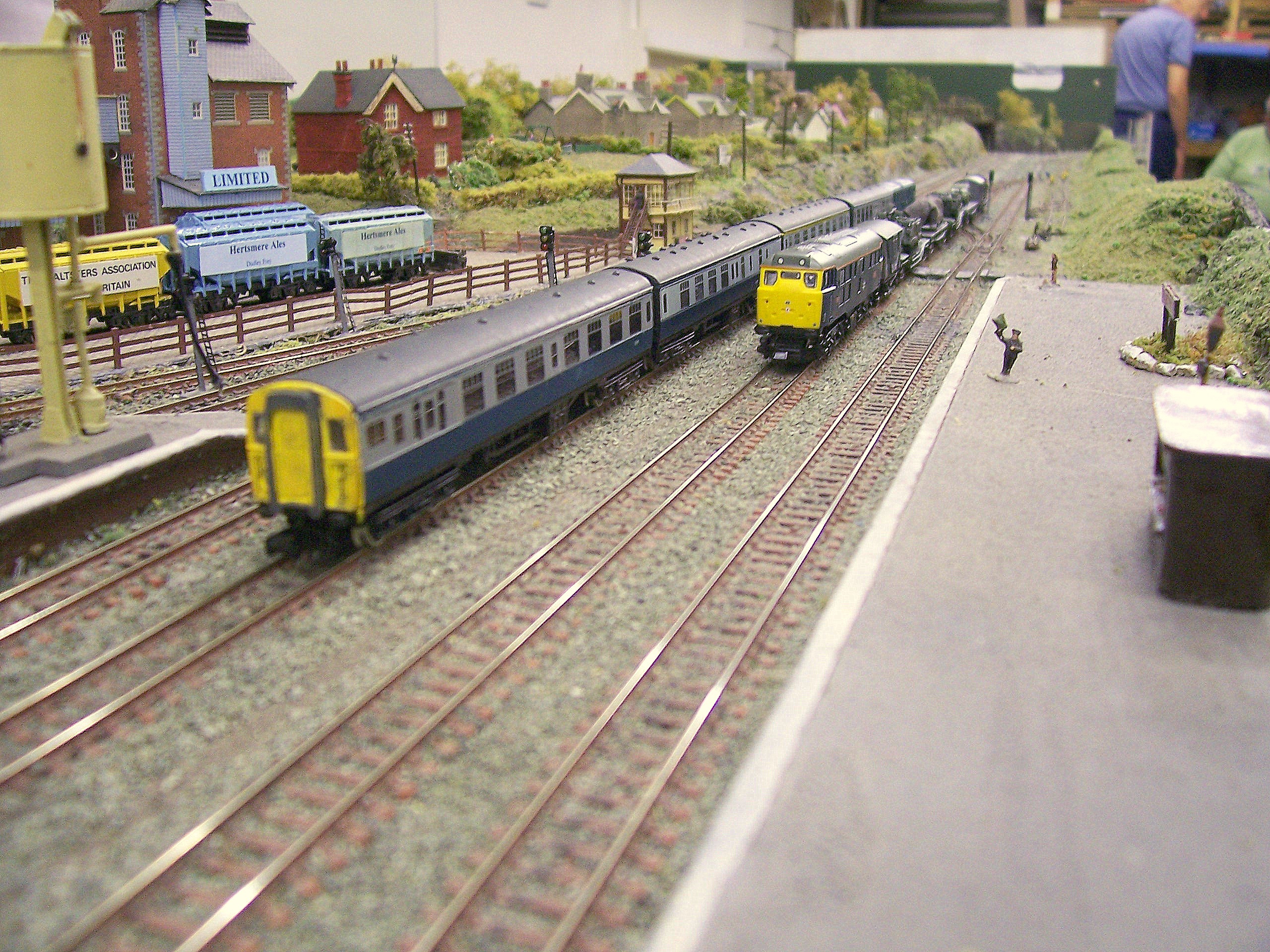
The actual size of the layout is 16′ by 3’3″ separating into four sections enabling it to be transported in members’ cars. It consists of four tracks laid as a tail chaser, the outer two being slow and the inner two being for the normal fast trains. The station is wired so that trains on the fast line can be brought into the platforms, both to serve the passengers and to allow other trains to overtake. There is also a goods yard where goods trains can call. Because the members interests are so varied the actual location and era has been deliberately left vague and the layout is now being run as steam in the morning and modern image in the afternoon at exhibitions.
A fully automated signalling system using three aspect lights is now fully operational. Passing units activate a sensor so changing each light within that track and in certain circumstances other tracks.
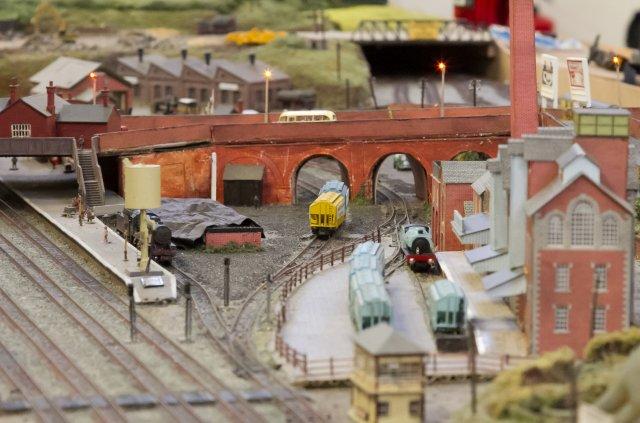
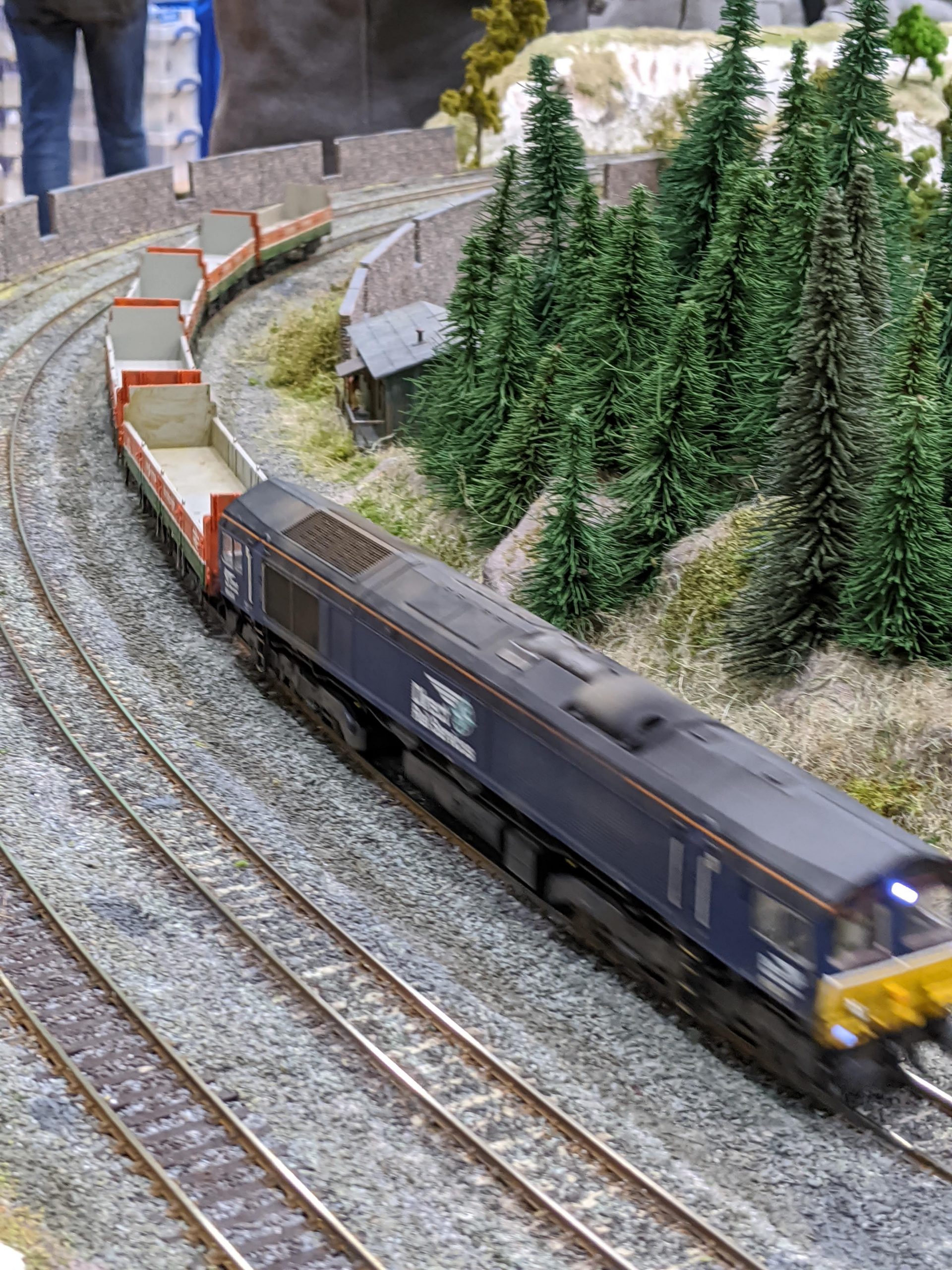
A post privatisation terminus west of Glasgow
Built and owned by Colin Heath, member of SW Herts MRS, the N Gauge Society and N Gauge Forum.
Allanbrae does not appear on any map. A Scottish sounding name emanating in large part from two operators who have provided invaluable assistance in recent years, it is probably located on the banks of Loch Lomond, or thereabouts. It is still operated by diesel traction some years after privatisation. Once a 5 platform terminus with a complex track arrangement it has been simplified considerably over the years, with the main approach being singled; only 3 platforms remain though the old Platform 5 is now a Royal Mail depot. The original platform 1 is now part of the car park and bus/taxi stands.
Services, primarily to Glasgow, Edinburgh and Stirling/Perth are operated by a mix of 156, 158 and 170 DMUs and sometimes a Voyager to Manchester. There is a daily portion of the Caledonian Sleeper. Mail trains serve the depot. This and the sleeper are hauled by Class 67s. Liveries cover a mix of years. Beyond the road bridge the kickback leads to a Traction depot for locos and an unspecified freight facility. Depending on my mood this might be an oil depot, a paper mill, aluminium works or Whisky distillery. Or a mix of these, so a Class 66 will also appear from time to time along with the 08 station shunter.
Inspiration for the layout included Helensburgh , Laargs and Iain Futers’ small Scottish layouts, including his O gauge layout Victoria Park.
Originally conceived as an extension to Dudley Frey, we are now constructing a small standalone layout suitable for taking to exhibitions. Details to be added in due course.
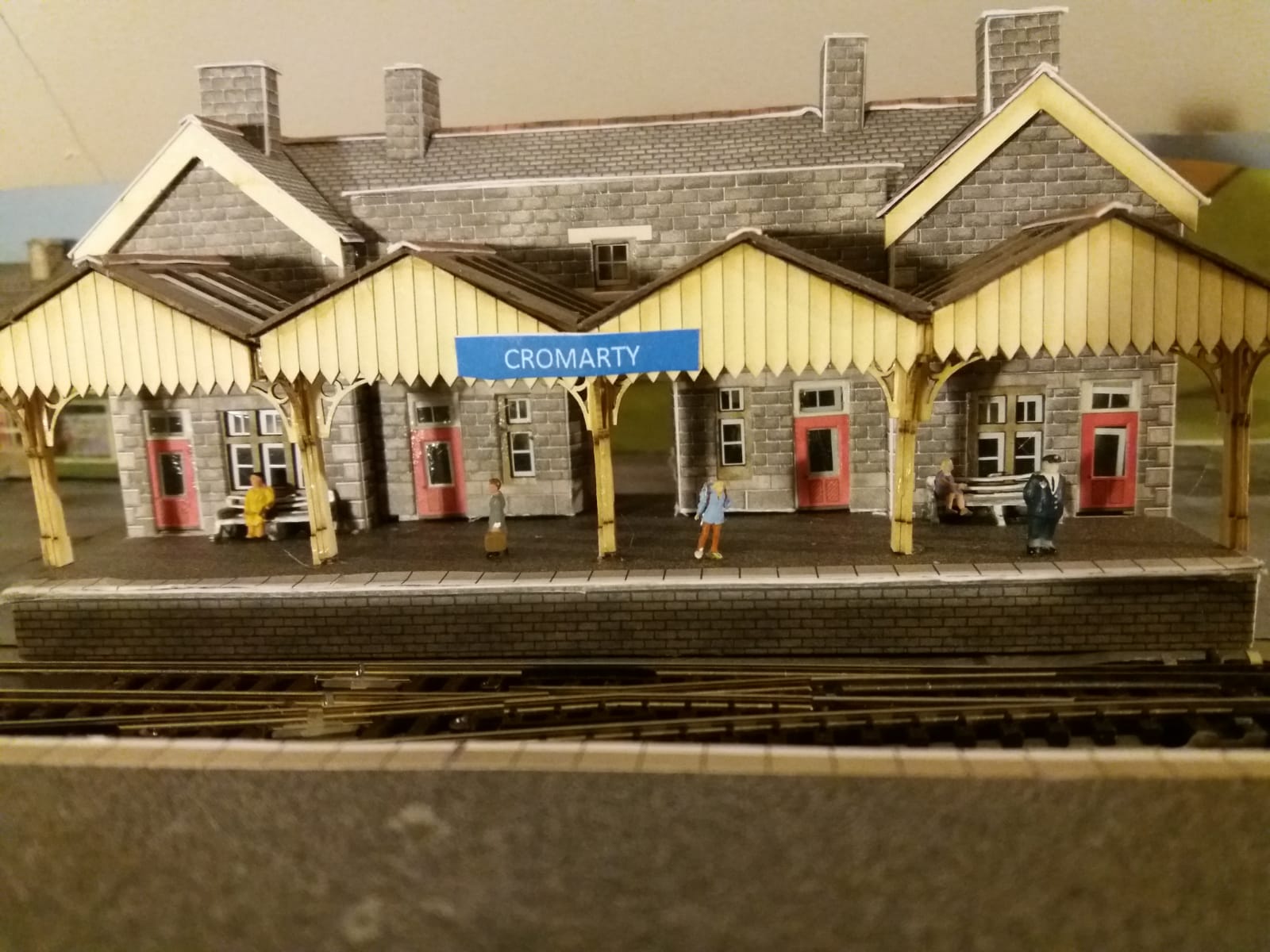
Many schemes were thought up for Railways on the Black Isle, north of Inverness. A branch was built from Muir of Ord to Fortrose. This layout assumes that it was extended, as some tried to do, to the fishing and holiday resort of Cromarty. It is assumed that while the Highland/LMS dominated, the GNoSR/LNER obtained the right to run trains from Aberdeen and other of their destinations. Tourist and fish traffic initially developed though such a line would have succumbed to the Axe by the mid/later 60s.
We will often start the day using steam locos but in the afternoon we may decide that motive power becomes diesel, with a class 120 DMU, Class 20, 24, 26 and 27 locos featuring. And the odd interloper in both eras. Apart from trains to Muir of Ord to connect with Kyle and Far North Line services, through trains are run from Inverness, Aberdeen and even Perth. On summer Saturdays there may be a train from Glasgow or Edinburgh.
Baseboards are plywood kits from White Rose. Track is Peco code 55. This is the first layout I have built since neurosurgery to correct the tremor in my right hand. I have used a number of kit buildings from Metcalfe.
For more information email
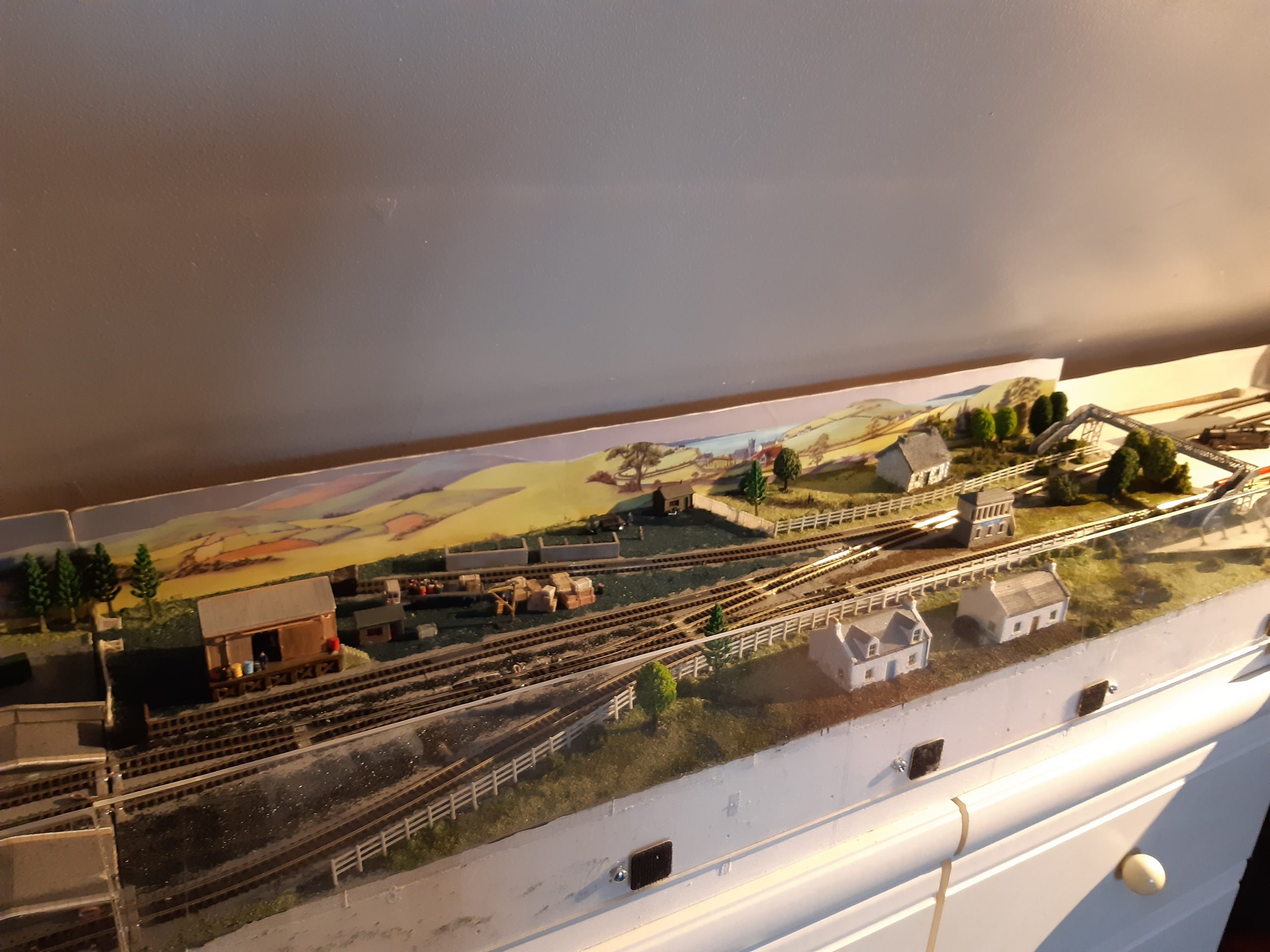
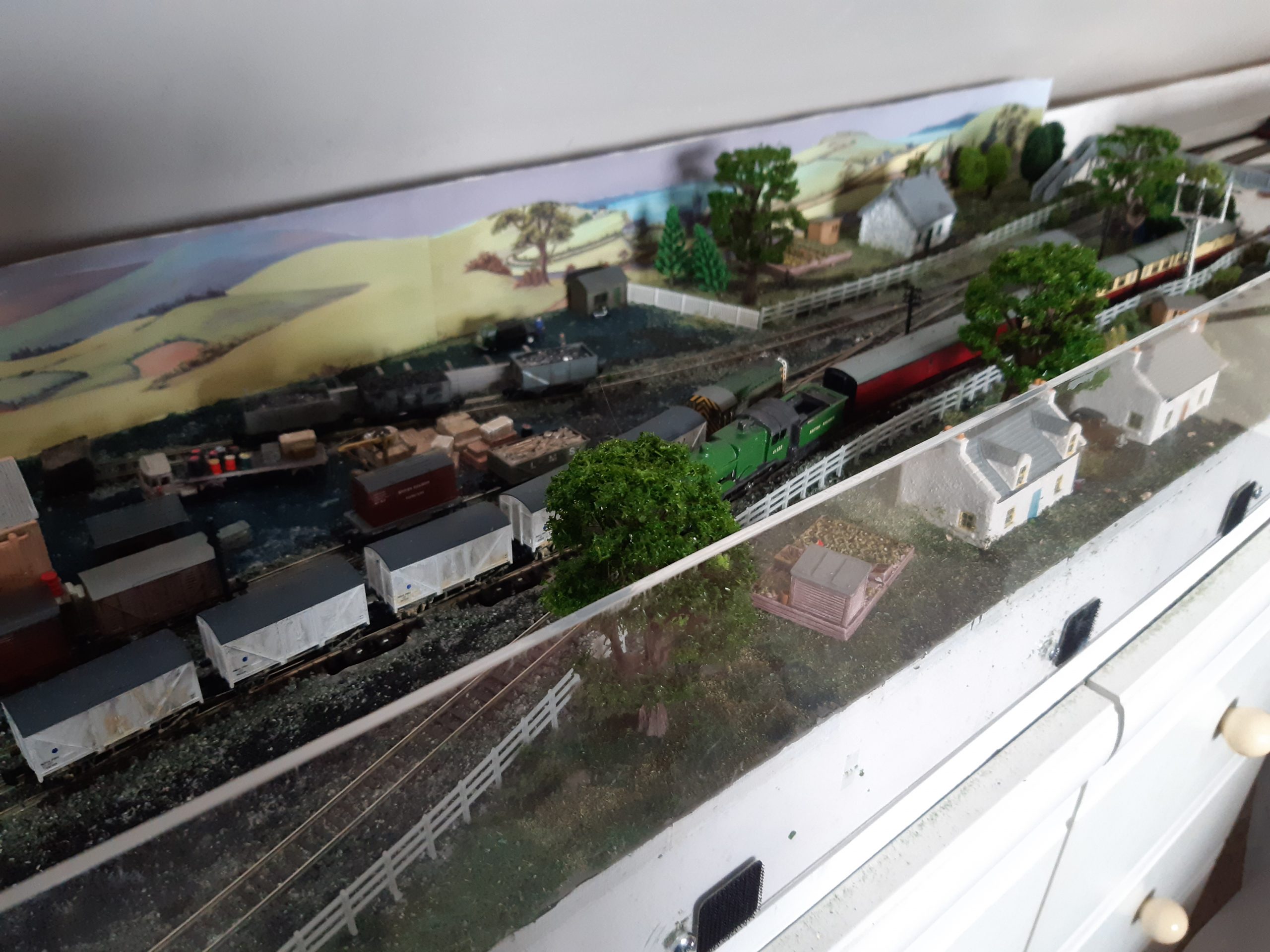
This 009 gauge diorama, 70cm x 60cm, is built on a 6mm pine wood base. Originally it was just an N gauge test track but to make it more interesting scenery was added.
The Loco featured is a Backwoods Miniatures kit of “Exe” a Manning Wardle 2-6-2T that ran on the Lynton & Barnstaple Railway.
The coaches are from Parkside Dundas of Festiniog & Blaenau, & Welsh Highland Railway and there are some open toaster rack coaches from the OO9 Society.
Scenery is polystyrene covered with poly filler and the rock faces are made with Woodland Scenic’s hydrocal and several of their rock moulds. The rocks were then coloured with their water based pigments.
The grass and ground cover is a combination of Woodland Scenics & Green Scenes and Realistic Models
The trees are Woodland Scenics kits.
In its present form Tansey Bank represents the main terminal station and engine shed on a preserved ex-industrial railway somewhere around Warwickshire in the early 1960s.
All of the rolling stock operating on the layout is either kit-built or a ready-to-run item. The stock has been fitted with Greenwich couplings which have proved reliable and given automatic uncoupling on a layout that is hopefully free from “the hand of God”. Every part of the layout has been weathered with acrylic paint, brown ink and matt varnish to create a uniform work-stained appearance.
Tansey Bank was featured in the October 2013 edition of Hornby Magazine.
If you have any questions about anything you see on the layout don’t hesitate to ask – things are never too busy down at Tansey Bank to stop and chat.
Pictures below courtesy of Trevor Jones and Hornby Magazine
Hobbs Row Halt is a classic English country micro-layout, complete with thatched cottage and “chocolate box” garden. It started out as a simple circular piece of track on an MDF “Wobble Board”, obtained from the local charity shop that I used for running in new locos. But after placing a couple of surplus buildings from my Tansey Bank layout inside the loop to check on coach clearances, I realised that a bit of scenery would not go amiss, and Hobbs Row Halt is the end result. The cottage is from the Bachmann Pendon Little Chapel Cottage resin model range and the magnificent trees are from the range of ready to plant foliage, now marketed by Debris of War. Hobbs Row Halt was featured in the August 2013 edition of Hornby Magazine.
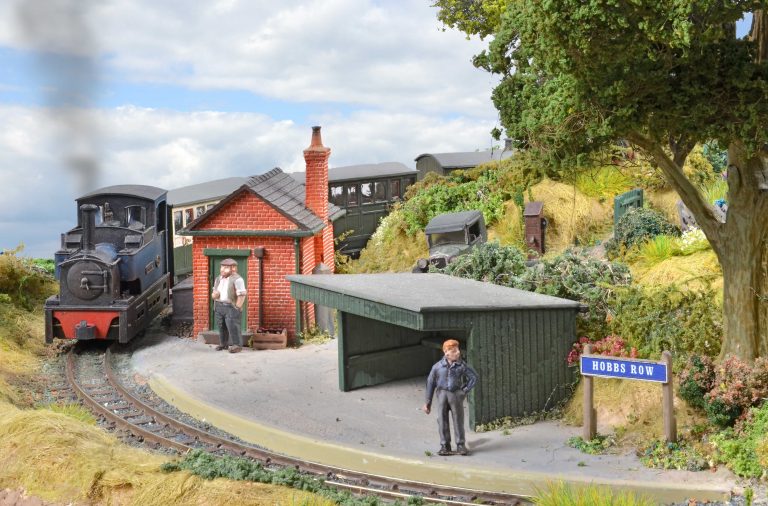
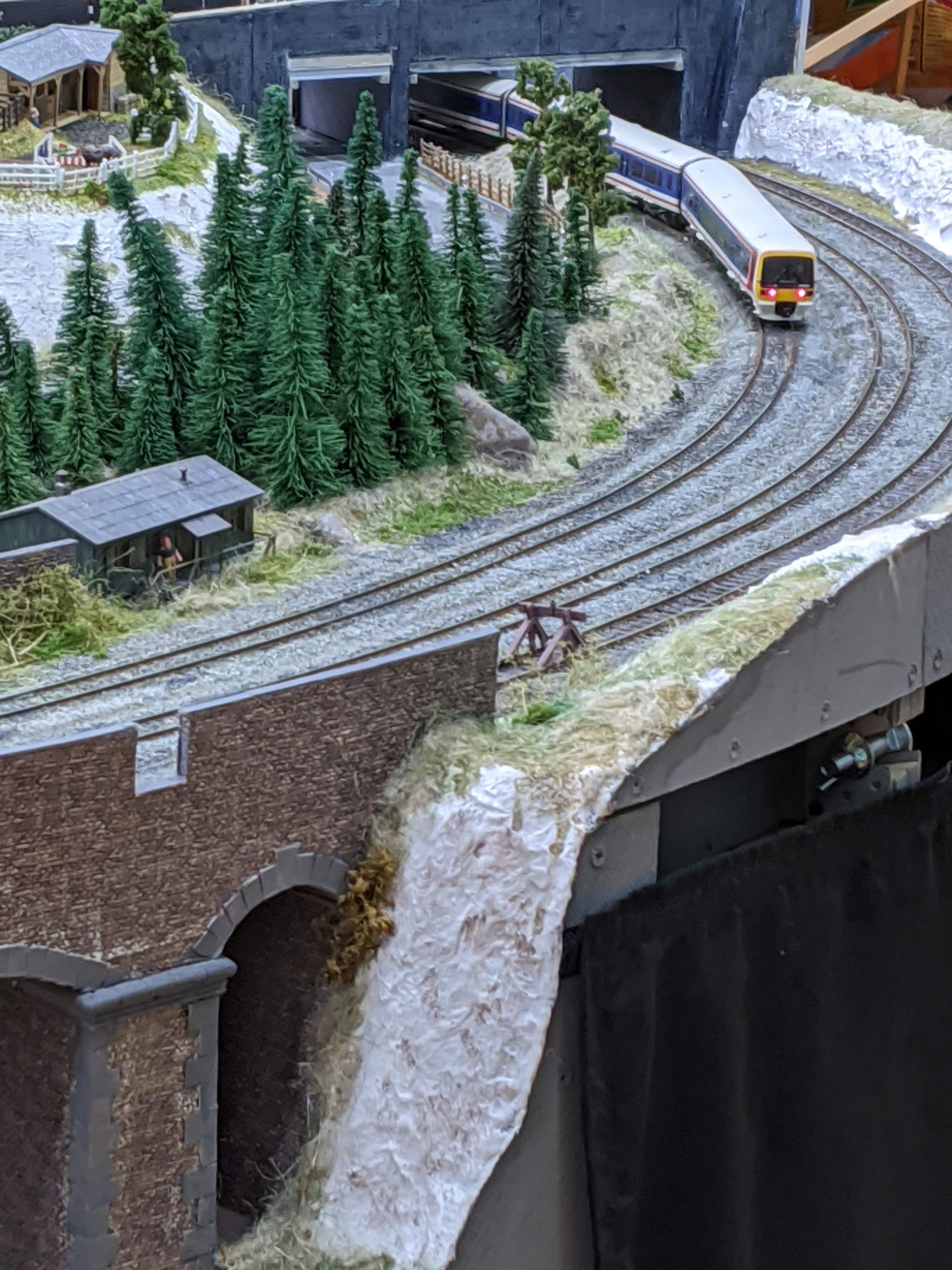
The idea with Silverbury was to create a modern image layout of the Great Central Railway if it had been made 4 tracks into London after the 1st world war, and if Dr Beeching had not closed the line, but instead reduced it to two tracks. What would it have looked like?
Silverbury is a combination of Silverstone and Aylesbury a “WHAT MIGHT HAVE BEEN” layout. The period modelled is BR Blue to the present day. It is placed at the edge of both Network South East (BR blue) and Chiltern Railways (Network Rail) so many trains would terminate at this point. It is also a mainline for long distance and Cross Country Passenger and through freight trains. This is to create plenty of interest for both operators and viewers.
It has been built in a modular construction which has allowed a more flexible and versatile approach with each base board being 4’ x 2’6” – (1.22m x .76m) and there are two half length boards.
The layout can be put together in FOUR basic formats.
- Hidden Yard to Hidden Yard with a station in the middle (36’ x 8’ – 11.5m x 2.5m).
- Hidden Yard to terminus Station, (28’ x 8’ – 8.6m x 2.5m)
- Similar to 2 but in the form of a ‘U’. (28’ x 12’ – 8.6m x 3.7m)
- A full round and round layout. (35’ x 12’ – 10.7m x 3.7m)
The hidden yards are two symmetrically opposite ends.
The additional boards can be added to give a full round and round layout 9′ x 29′ which gives a nominal footprint of 35′ x 12′ (10.7m x 3.7m) as mentioned above.
It is helpful to have a stock table behind the layout for stock management-if possible – as we operate inside and from rear of layout.
We use MERG’s Cbus system to control and sense the points and we’re able to set routes into and out of the 11 road fiddle yards with one push button switch.
We’re also using MERG’s DCC equipment and JMRI to operate the locomotives, several of which have sound units.
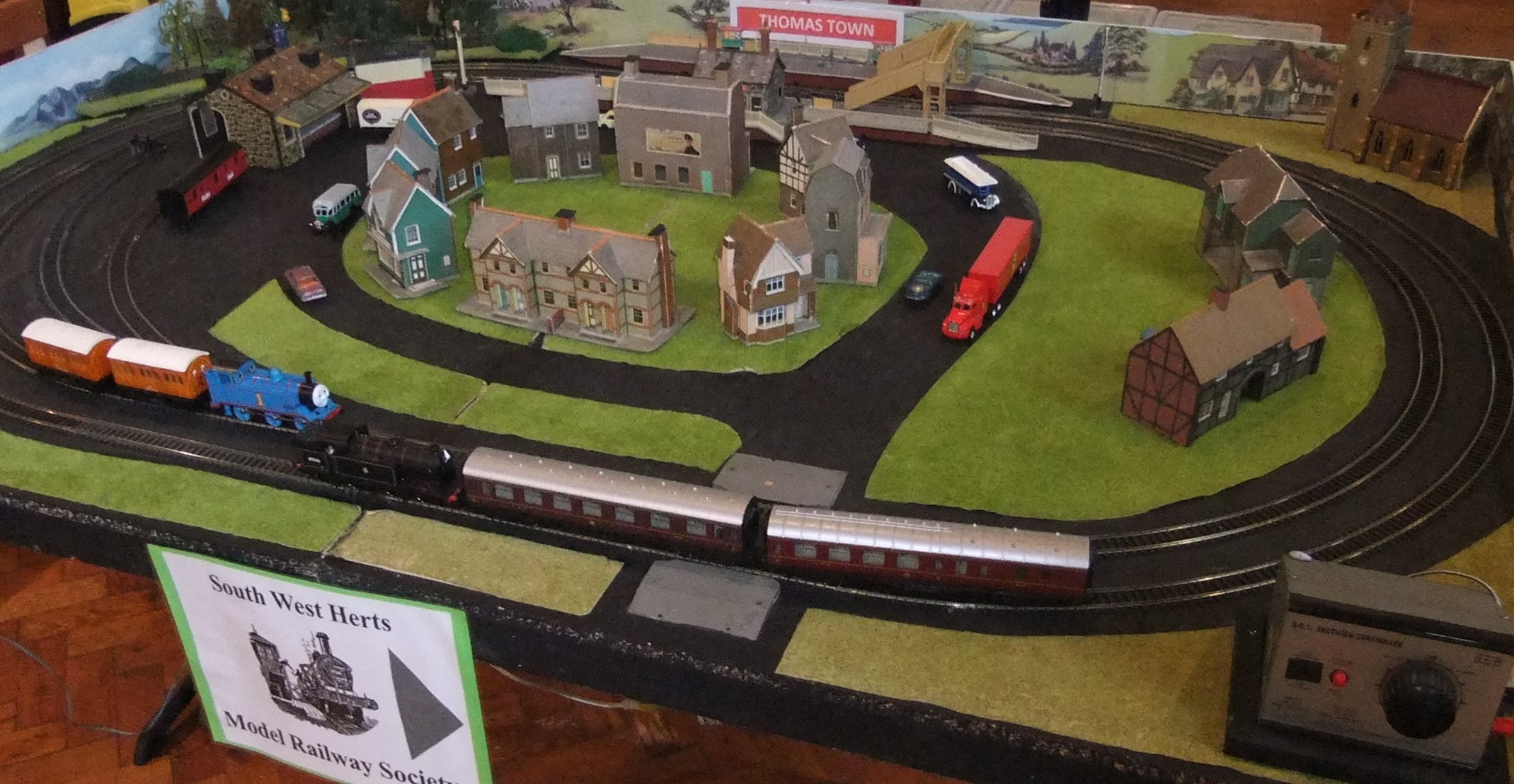
This layout opportunity to operate Thomas the Tank Engine and friends from the district of Sodor for a small charity donation.
The layout is mounted on a 6ft x 4ft board with own legs cutdown to 2ft 6in high to suit operation by children.
We obtained a part-built ’00’ gauge layout with an interesting track layout – a double loop that invites onlookers to spot where the train will appear from next. It was named Fudge Town somewhat in jest to reflect the state of the baseboard and the extensive changes necessary to make it work properly. We added a control panel and point motors and let our scenery enthusiasts loose on the diorama. This involved not only adding a third street level and a road along the back, but a mine too.
We can run almost any 00 gauge locomotives, carriages and wagons – all on conventional DC control to allow older models to be operated.
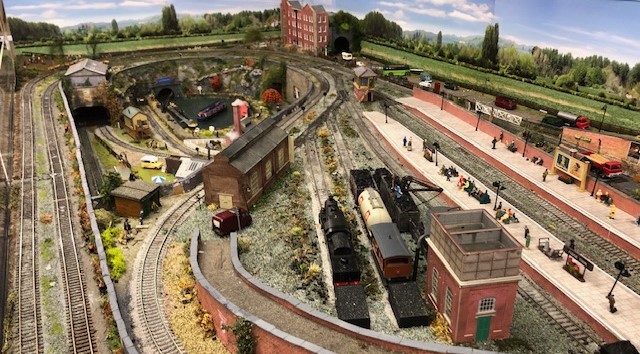
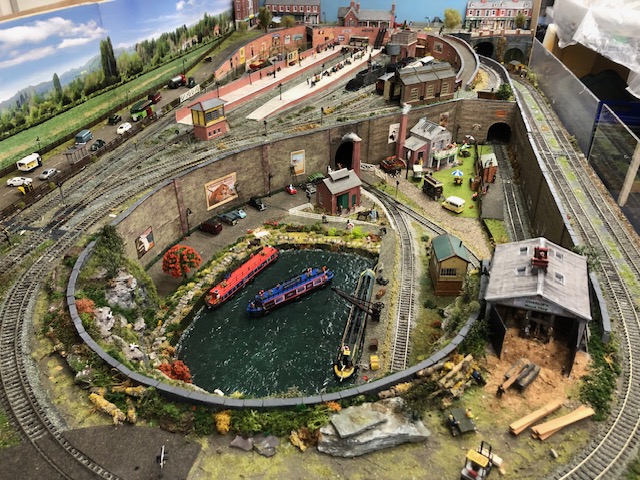
The layout was purchased by SWHMRS from an ex-member of the Bushey club in 2014. Only part of the layout was operational so we are now undertaking a major redesign project which will facilitate the varying eras and operating companies of members’ rolling stock.
This fictional line is set in the South Midlands during the time era from just after the Second World War to the late 1950’s. Thus all members will be able to run their stock on the layout without feeling out of place.
Luffield Junction lies about midway along the line, on the Northants/Bucks border, where two lines converge from the North and North West. LMS and LNER have running rights along the whole length of the line, while GWR and Southern run North as far as Luffield. Northants/Bucks border, where two lines converge from the North and North West. LMS and LNER have running rights along the whole length of the line, while GWR and Southern run North as far as Luffield.
The layout will be DCC operated via control panels mounted on the rear.
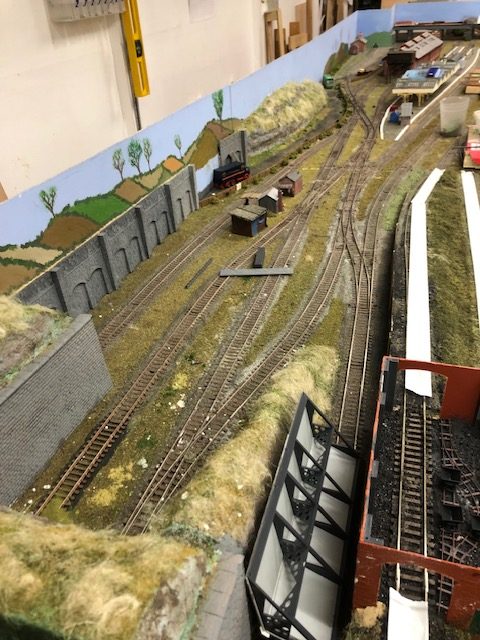
Location Waldviertel in Lower Austria – through junction station, located on a subsidiary line running from Zwettl to Horn, the standard gauge branch heading to Huf. The narrow-gauge heading South to Krumau am Kamp.
Whilst the main running line is electrified both the narrow-gauge and the branch are not-relying on diesel and steam traction. The narrow-gauge merges in the station area using Tillig dual gauge trackwork.
The era modelled is from the late 1970’s onwards- This allows a flexibility in the range of rolling stock, so that interesting items may appear from time to time.
The locations of Horn, Zwettl and Krumau am Kamp exist – the rest is fiction.
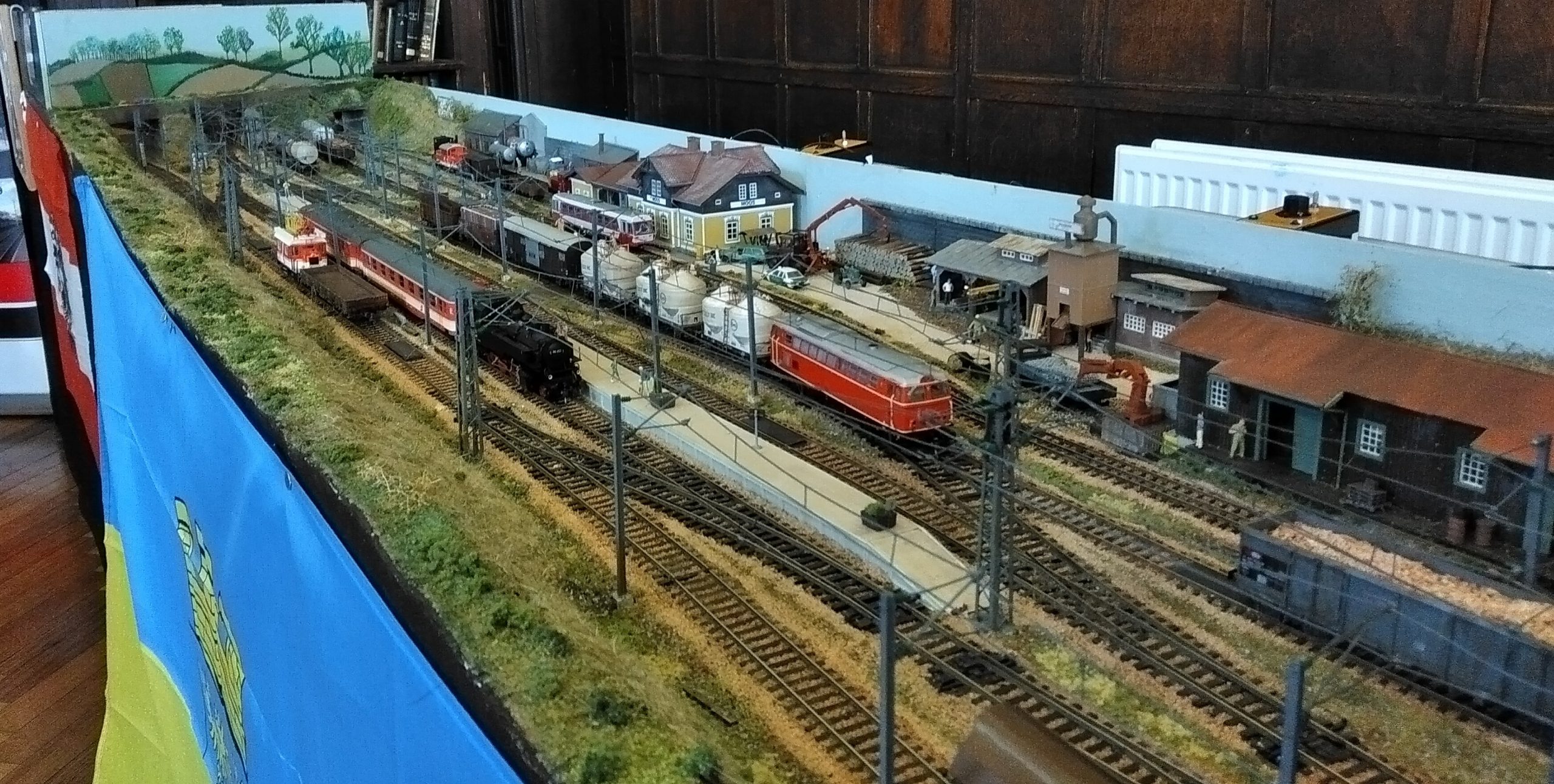
The OBB station at Klapping is a truncated terminus station. The line is electrified using catenary. There is in addition a diesel freight feeder line, together with a goods yard also using diesel traction maximising the operational interest.
The local steam and nostalgia preservation group also make use of the branch to move locos onto the main OBB metals.
The layout is 18’x2’it is self-supporting on trestles. The track used is Peco code 75 electrofrog points etc, the catenary is by Sommerfeldt.
Period portrayed is ten years backward from the day of the exhibition, allowing us to show off a wide range of OBB locomotives and rolling stock.
In reality the location is near Graz – Klapping is Spatenhof the main running line ran to Lannach (cut by A2 road upgrade). The diesel Branch runs to Tobelbad.
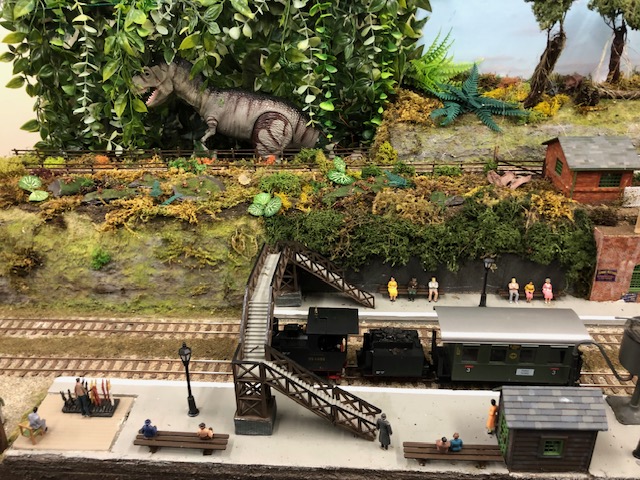
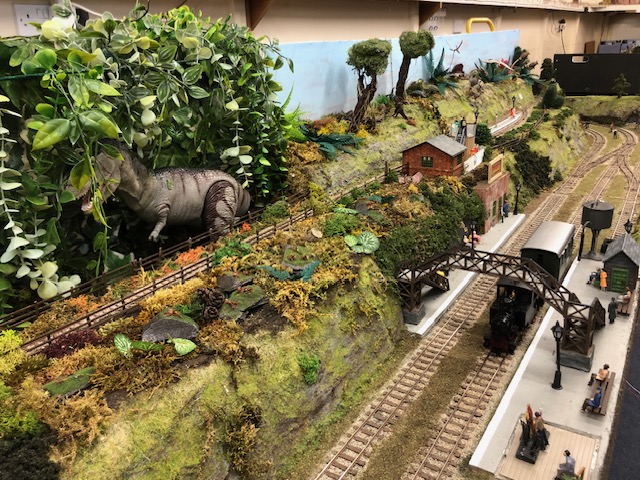
Jurassic Halt is a narrow-gauge club layout built in O scale (7mm/ft) scale on 16.5mm gauge track (O16.5) and on 9mm gauge track (O9). The layout is based on a ‘what if’ scenario assuming the famous dinosaur park (as seen in the films) was serviced with narrow gauge railways.
The main park railway is on the lower level and takes visitors round the park to view the dinosaurs. This track is also used to look after the animals – look out for the trains bringing the food for the dinosaurs and also to transport the smaller assets.
Visitors to the upper-level station can catch a train to the interchange with the main railway and also to other parts of the park.
Watch out for visits from the moving dinosaurs – please do not feed!
Technical Information
Track is Peco O16.5 type for the main line and Peco OO9 for the smaller gauge. The modelled scale is 1:43 which is the same as British O gauge. The main line gauge is 16.5mm so loco mechanisms from HO/OO can be used. This represents 2ft 4in gauge, similar to the narrow gauge railways in Wales. The smaller gauge is 9mm so N gauge mechanisms can be used. This represents a 15 inch gauge line similar to the Romney, Hythe & Dymchurch in Kent and Bicton Park in Devon.
Locos are all dc and points are solenoid operated. Stock is a mix from various kits on ready to run chassis by Hornby and Bachmann with ready to run trains from the Magic Train system by Fleischmann. See separate lists of locos.
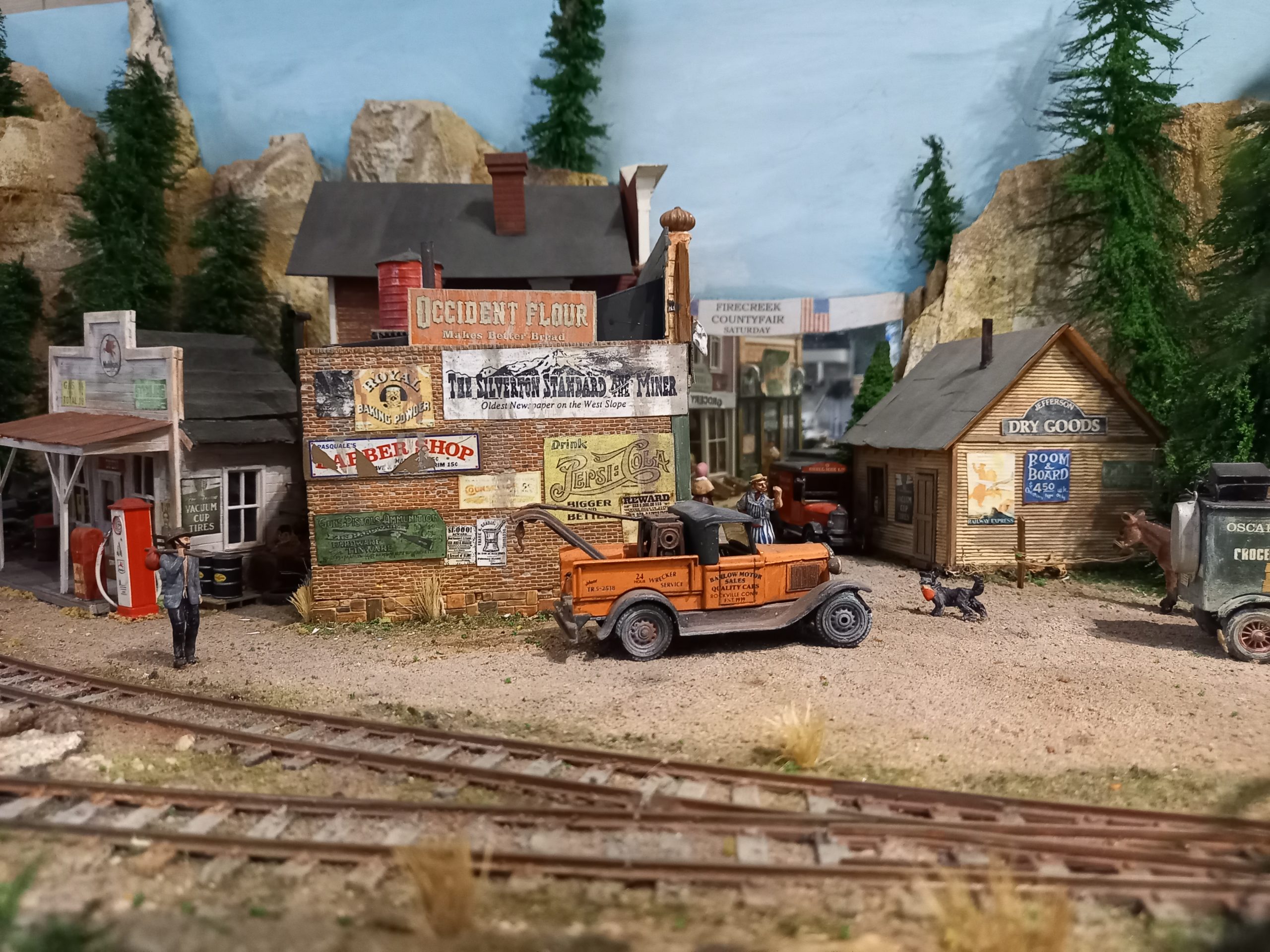
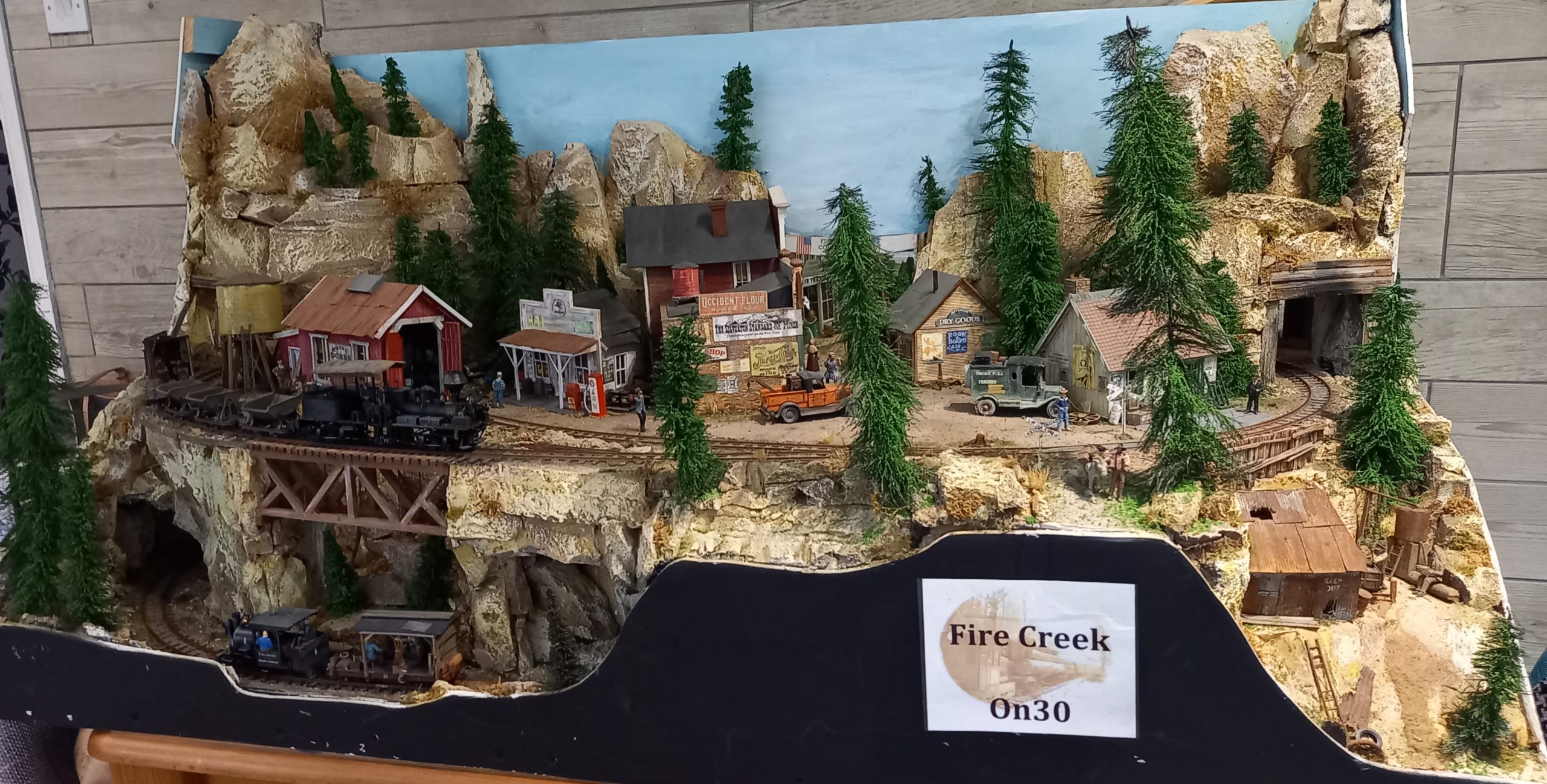
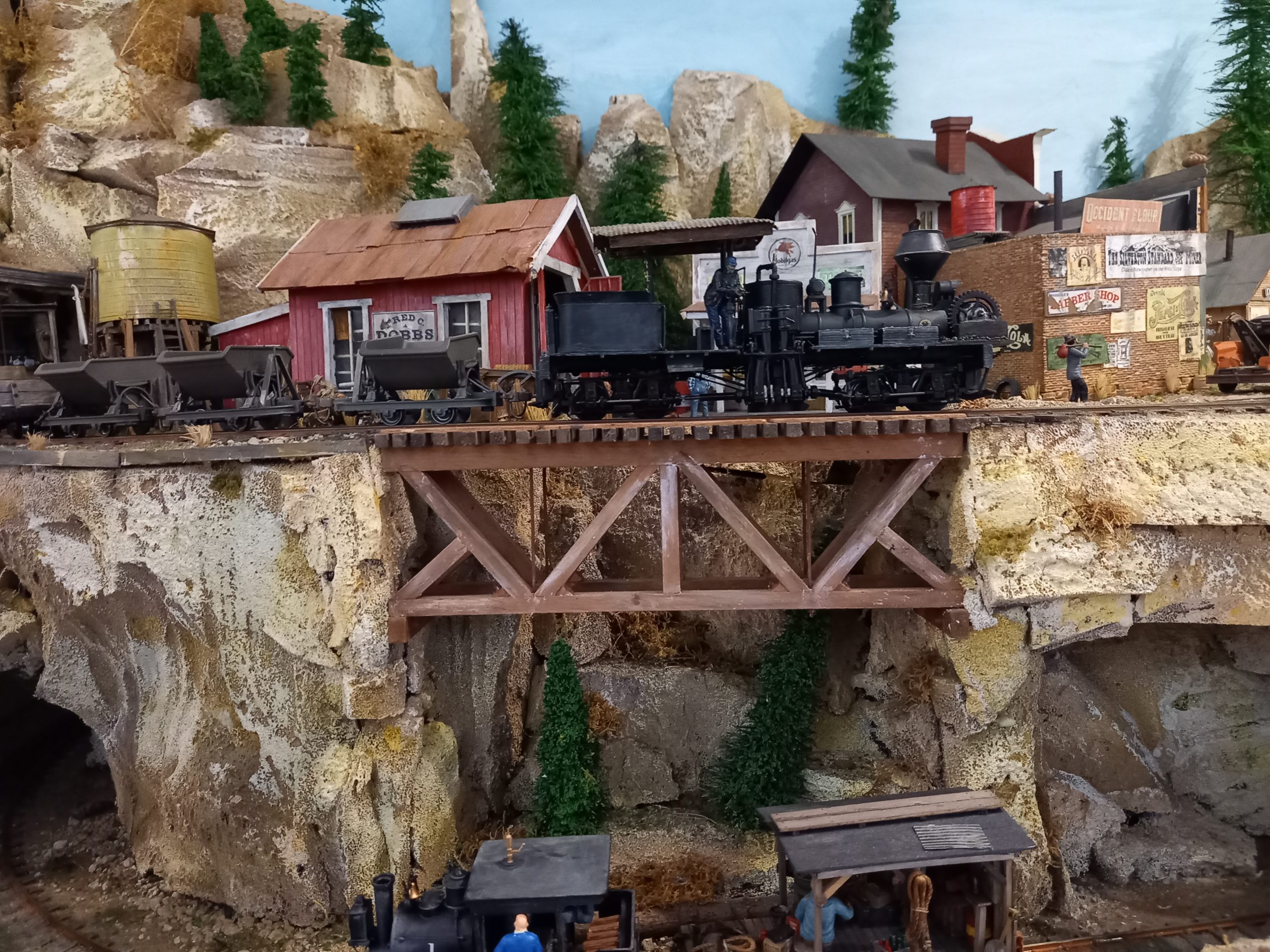
Fire Creek is an 0n30 American layout loosely bases on a Colorado mining and logging town in the 1930s, all buildings and scenery are scratch built.
Size: 5ft x 3ft. Unsupported – requires table top.
Exhibited by Ian Graham (SWHMRS member)
Layout background
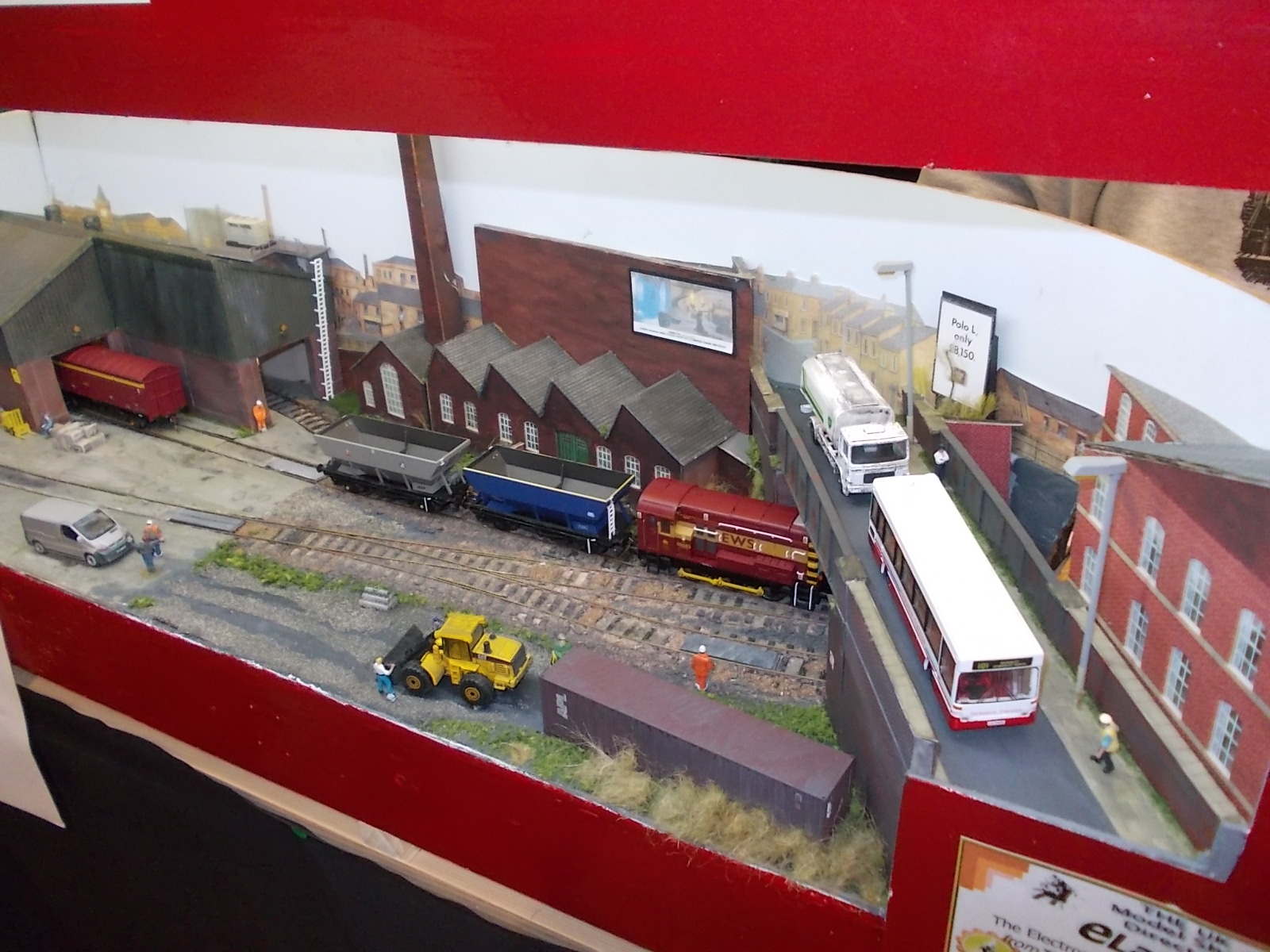
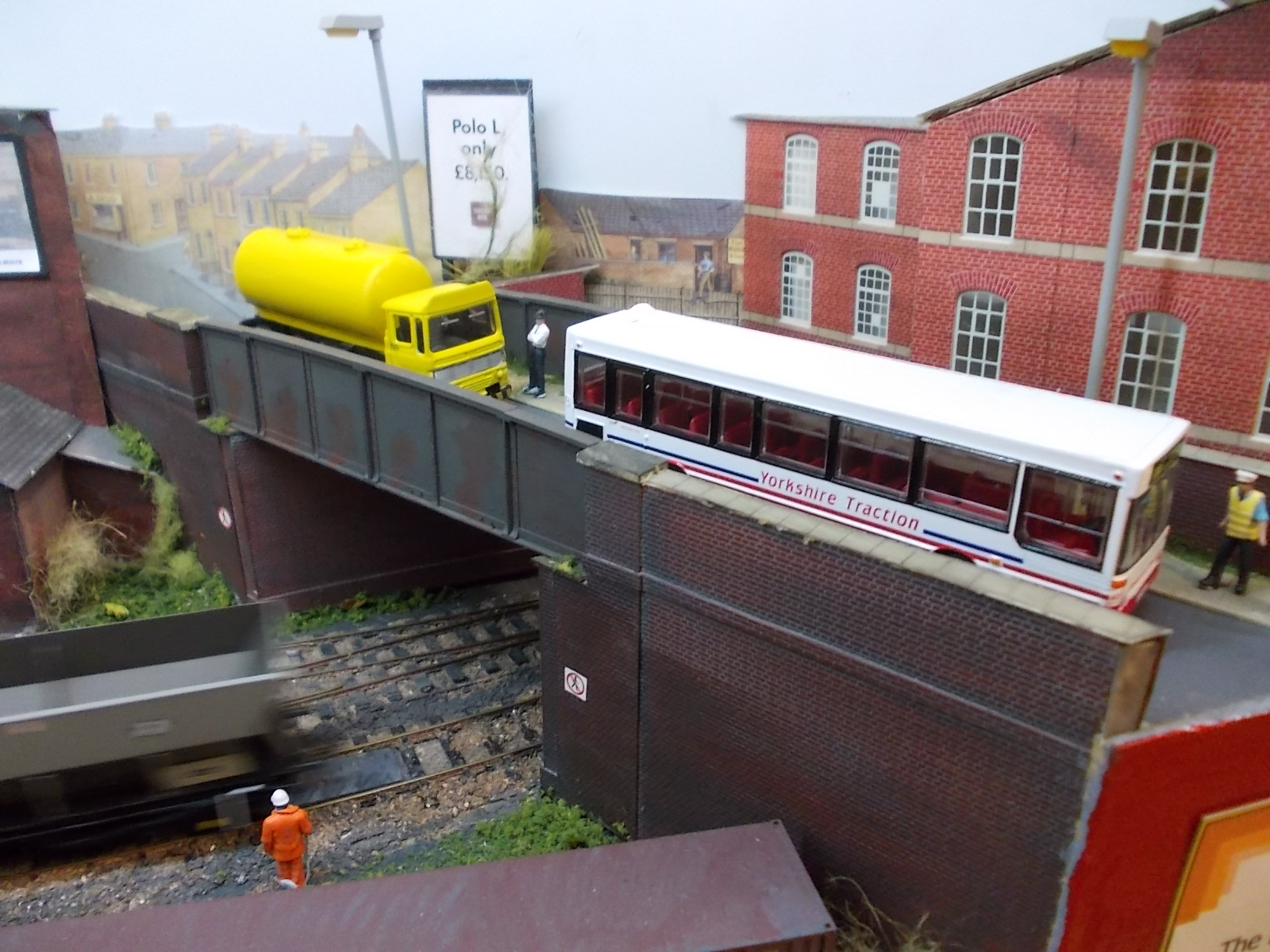
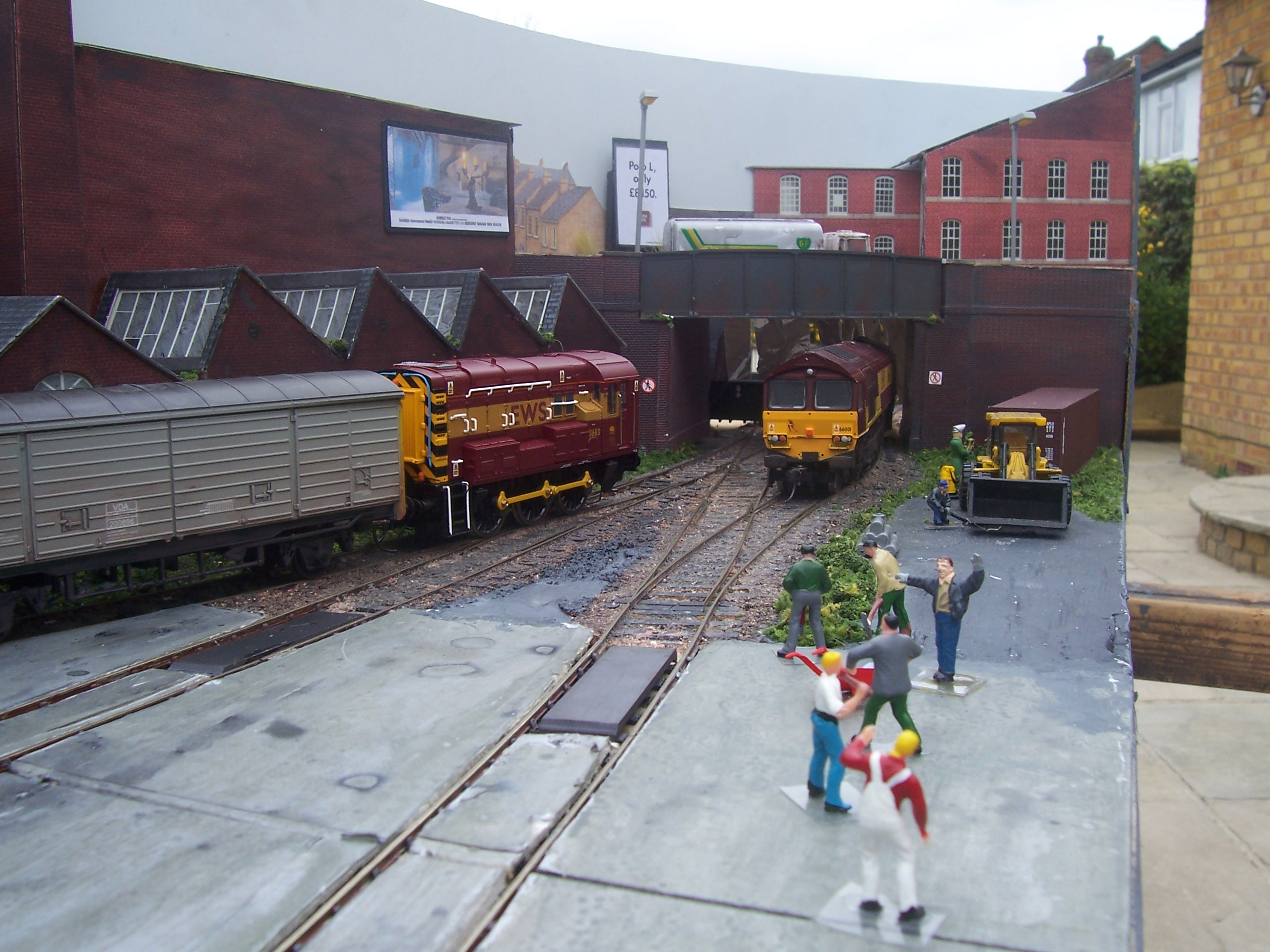
Part of as large wagon manufacturing and repair works set in Yorkshire in the late 1990s. Locos and stock represent the sectorised and privatised liveries leading up to that time. The layout has track inside the wagon works buildings (for wagon exchange) plus a fiddle yard link to the national rail network. Health and safety is a priority with warning lights and sirens for wagon movements onto and out of buildings.
Technical Details
The layout is built on a recycled baseboard frame of 50mm x 25m timber forming a 1.2m x 0.3m board with a Sundeala top. Track is EM flexitrack with handmade points (this is my first venture into track construction and EM gauge). Point control is wire in tube with micro switches for live frog polarity switching. The wagon works and bridges are scratchbuilt and the half relief buildings are from the Metcalfe range heavily modified. Figures and details are from a variety of sources including Matchbox, EFE, Corgi, Preiser, Merit etc.
Locos and stock are Hornby, Bachmann and Lima with added details and weathering, re wheeled to EM gauge and couplings changed to Kaydee. Warning lights and sirens are from Maplin kits and street lights are Veissmann. Control is normally from an old H&M Clipper for DC operation, but the layout has been run as DCC with all track sections switched on and using a suitable controller and locos.